Permanent Exhibition in Cultural Centre Jules Pascin in Vidin

Permanent Exhibition in Cultural Centre Jules Pascin in Vidin

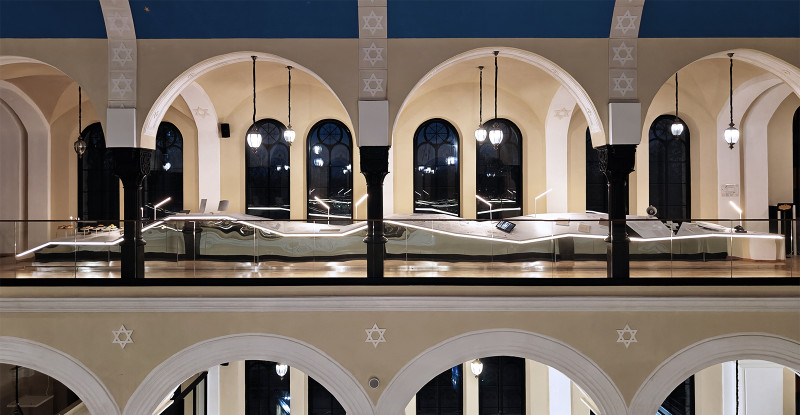
The theme of humanity, tolerance, and communication between people emerged as the central idea shaping the content of the permanent exhibition. It highlights the power of tolerant interaction from two complementary perspectives: on the one hand, through the prism of the Jewish community of Vidin, told via stories of the city itself — a centuries-old, multiethnic and multicultural Danube town; and on the other hand, through the individual, via stories from the life and work of Jules Pascin — a world-renowned Jew from Vidin.

The architectural concept is inspired by the qualities of the spaces within the cultural centre and seeks to utilise and emphasise them. The spatial narrative begins with an invitation for visitors to gather around two long tables — an invitation to communication, discovery, and shared experience. Interaction with visitors is based on the principle of “action.” Information is revealed through bending down, touching, lifting, turning, and peering inside. It is arranged in several layers in relation to the table surface — within it, on it (texts and graphics), and above it (emerging objects) — so that different media and levels interactively convey messages.

Our role was to develop the overall narrative — content-based, scenographic, and spatial — from the initial concept through all stages of the project’s implementation and process management. The sensory journey we created weaves together a rich palette of food, paintings, models, comics, films, documents, immersive sounds, first-person narratives, and many other unexpected encounters.

Permanent Exhibition at Konaka History Museum in Vidin

Permanent Exhibition at Konaka History Museum in Vidin

The project for the permanent exhibition at Konaka History Museum presents the millennia-long history of the Vidin region, unfolding within the building’s historic spaces. The architectural concept deliberately emphasizes their atmosphere and inherent values, transforming them into active carriers of the narrative.

The exhibition is based on the thematic structure developed by the museum’s scientific team and follows the principle of linear chronology.  The artifacts are placed at the center of attention, strategically positioned in the core of each gallery, where they resonate both as part of a collective narrative and as bearers of individual stories.

The modular exhibition elements function as visual and spatial storytellers, revealing both the tangible and intangible heritage of the region. Designed as independent museum furniture, they do not affect the building’s structure. Complementary seating elements provide spaces for rest, contemplation, and a deeper engagement with the exhibition.

Entomology Exhibition in the National Museum of Natural History at BAS

Entomology Exhibition in the National Museum of Natural History at BAS

The project for the new permanent exhibition in the “Entomology” hall is the result of our joint work with the team of the National Museum of Natural History at the Bulgarian Academy of Sciences. As architects, we first explored the space and drew inspiration both from the interior and from the museum building as a whole. The building is particularly interesting as it was the first of its kind in Sofia at the time — constructed in the 1930s specifically to serve as a museum. For this reason, we decided to preserve and highlight the existing spaces and details of the interior. The most characteristic interior element is the mosaic floor, and our project therefore aims to keep it as visible as possible. We also use the historic insect display boxes as a link to the past and to the history of entomological research.

In developing the concept, the museum team participated actively with their expertise, while our role was to translate the scientific information into a spatial and sensory language. In this way, we were able to highlight, through various approaches, both the systematic aspect of the information and the more holistic stories about the lives of insects and their coexistence with us.

The suspended wall in the middle of the hall is the literal and metaphorical backbone of the exhibition. Using a systematic method, this wall presents scientific knowledge about the structure of insects — who they are, what distinguishes them from other species, and what distinguishes them from one another.

The holistic section offers a series of immersive experiences, such as a fieldwork cabinet, where visitors learn how the study of insects in Bulgaria began and how it takes place today. In the night bar, visitors are immersed in the sounds and nocturnal activities of insects. The shared apartment, the beehive, and many other scenarios emphasize the place of insects in our lives and in the world as a whole.

The overarching idea of the exhibition, which unifies and gives meaning to all these narratives, is “The Butterfly Effect.” It is based on the understanding that every action or small change influences the whole, most often in ways that are unpredictable to us. The central idea and the approaches through which it is presented highlight the growing need for contemporary exhibitions to present facts and interdependencies in a holistic, accessible, and engaging way for visitors.

Listen to Bozhentsi Exhibition

Listen to Bozhentsi Exhibition

“Listen to Bozhentsi” shares many stories about the enterprising people of Bozhentsi — founders, merchants, craftsmen, builders, and benefactors. The exhibition teaches their lessons through games, storytelling, and surprising discoveries, showing the many ways in which we, too, can be enterprising.

At the center of the hall, we created the “Tezgyah” (market stall), where visitors receive hands-on lessons in entrepreneurship in a fun and engaging way. The stall and its interactions were also inspired by the workshops regularly organized by the museum team. In this way, we build upon the museum’s valuable practices, well-known and loved by Bozhentsi’s visitors. At the stall, objects form a kind of theater that encourages playful exploration of materials and artifacts. Visitors search for and discover the stories these objects tell.

Our role was leading — from shaping the visitor experience to transforming history into spatial narratives through the objects and installations of the stall. The museum team contributed the intriguing legends of Bozhentsi, while we, the architects, devised the playful ways in which they come alive in space.

Temporary Installation “Step Up and Face Fear!”

Temporary Installation “Step Up and Face Fear!”

The installation is part of the traveling exhibition Fake (f)or Real: the History of Forgery and Falsifications, House of European History, Brussels, which was hosted by the National Ethnographic Museum in 2024.

In addition to the guest exhibition, our role was to develop the concept and carry out the final installation — a special Bulgarian contribution. The experience offers visitors the opportunity to learn more about some of the tools of the propaganda machine today and in Bulgaria’s recent past. To help us tell the difference, the installation “Step Up and Face Fear!” shows how Bulgarian organizations such as Sofia Platform and the Foundation for Humanitarian and Social Studies help us better distinguish truth from disinformation.

One part of the installation focuses on exposing the main mechanisms of contemporary propaganda — so-called “mushroom websites” that spread fake news with the help of computer algorithms. Visitors are immersed in a multiplied space of mirrored walls with screens broadcasting fake anonymous news. The “mushrooms” sprouting from the ceiling of the installation, also endlessly reflected in the mirrored surfaces, symbolically contribute to the sense of propaganda surrounding us.

The other part of the installation presents the quieter voice of truth, which belongs to the real person with their own face. The personal testimonies of survivors of the Belene labor camp expose the mechanisms of propaganda and the suppression of differing views during the totalitarian regime.

The installation “Step Up and Face Fear!” presents truth and falsehood as an inseparable part of our lives, while reminding us that whether we live with one or the other depends on each of us.

Permanent Exhibition of the Historical Museum of Dupnitsa

Permanent Exhibition of the Historical Museum of Dupnitsa

The main objective of the new permanent exhibition is to transform the Historical Museum of Dupnitsa into a platform for encounter between the local community and local culture, and to activate interest in the area’s heritage.

The organization of the exhibition — both thematic and chronological, in terms of content and spatial arrangement—is based on the concept of storytelling, credibly and engagingly narrated by the “embroidery-storyteller.”

The museum spaces are transformed into a three-dimensional embroidery — the most vivid and recognizable element of Dupnitsa’s heritage. This “living” embroidery conveys a single overarching message: Dupnitsa holds extraordinary and unique stories from different periods, firmly woven into the fabric of the region. Enter the embroidery and listen to, see, and touch these stories. Step into the role of the weaver, wander through time, and follow the threads toward unexpected connections—from Antiquity to the present day.

The Story of & Interactive Exhibition

The Story of & Interactive Exhibition

With the interactive exhibition, the America for Bulgaria Foundation celebrates its 15th anniversary and the successes of the organizations and projects supported by the Foundation over the years. 

This story is about the conjunction “and” (&) – a story about people and organizations working and succeeding together.

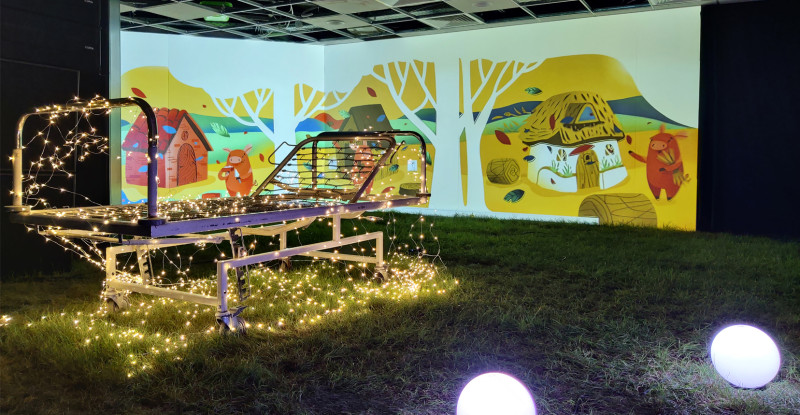
With the interactive exhibition, we set ourselves the goal of immersing the audience in a sensory experience – an interpretation of life, where dreams meet reality. The main challenge was to tell the story of 1217 realized projects and dreams come true in a 30-minute performance in two halls on the ground floor of the National Palace of Culture.

Our role was leading both in creating the concept of the visitor experience and in materializing the story in the space using the objects and installations as storytellers. The sensory journey includes walking on real grass, meeting the avatars of cеlebrities and heroes, intertwining the present and the possible bright future with the help of fantastic illustrations, playing with lights and shadows and many more unexpected situations.

Treasures from Vratsa Exhibition

Treasures from Vratsa Exhibition

The main goal of the project was to rethink an outdated museum space and present the treasures that are displayed there in an exciting, fun, and unforgettable way. In the hall are presented both unique world-class artifacts, such as the Gold Wreath and the Greave from the Mogilanska Mound, as well as masterfully crafted, yet everyday objects from the Antiquity, the Middle Ages, and the National Revival. It was necessary that these various artifacts, different in function, make, and period, be bound together into one whole. The valuable pieces of jewellery had to be displayed in a protective environment and be illuminated in an adequate way, but also to be provided with the necessary information, without ruining the visitors’ experience and the immediate contact with the real objects.

The concept of the project is to create a complete scenographic experience through synergy between architecture, content, and design of the Treasures from Vratsa Exhibition. At the heart of the architectural approach is the idea that treasures live beyond time and space. The room is completely dark to make the visitor completely lose the sense of space. The main element is the so-called Horizon – the long illuminated display case in which the treasures are presented chronologically and thematically. The gradient change from light blue to red interprets the eternal flow of time. In two pillars in the middle of the exhibition space, the two most important and valuable artifacts – the Gold Wreath and the Greave from the Mogilanska Mound – are displayed. 

All artifacts are supported by bespoke mounts and appear as if they are levitating in the display cases. The main purpose of this manner of display is to emphasize the objects and their craftsmanship. All information about the artifacts from the Horizon is presented in a delicately lit console, where through texts, illustrations, movies, casts, tactile and interactive elements, the stories are told.

The display of the Wreath and the Greave follow the same logic. Attention is drawn to them and the information is placed on the backs of the pillars.

The exhibition design engages all the senses to enhance the overall experience. Entering the room, one feels the change in temperature. The ambient music, along with the whimsical mapping above the long display case, creates a fairy atmosphere in the room. Several illuminated resin casts of artifacts and specially made traditional pafti belt buckles allow everyone to feel with their fingers even the finest details. Last but not least is the specially designed installation, by which you can feel the scent of the gold laurel wreath – the humble bay leaf.

The Treasures from Vratsa Exhibition is designed to immerse the visitors in its atmosphere, while at the same time creating optimal conditions for safeguarding and presenting the treasures. The design engages visitors of all ages and interests, based on easy and intuitive ways of presenting information.

Ada Tepe Exhibition

Ada Tepe Exhibition

Ada Tepe is the mountain peak where the oldest known gold mine in Europe has been found and studied. Now gold is being mined again and all traces from the Bronze-Age mining technology will disappear. The main challenge of the project is to reveal the “absent” heritage of ancient gold mining.

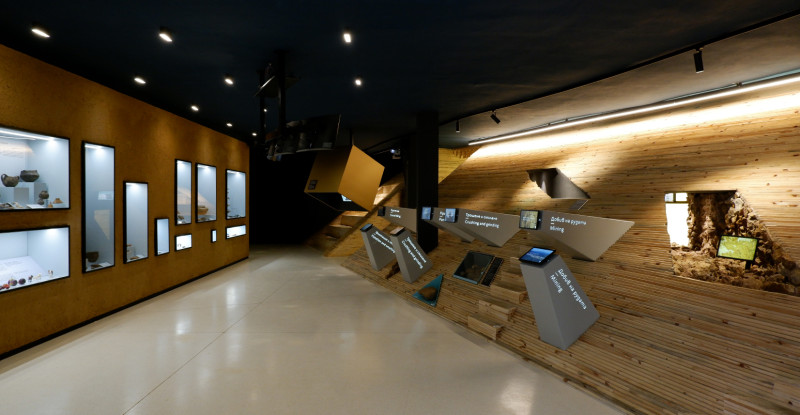
Ada Tepe Exhibition is located in a disused room of a local community centre. The exhibition covers several topics: gold mining in the Bronze Age and now, the life at the mine, the peak, the excavations, the gold, the nature, and the future of the mine. Their manifestations in terms of spatial and architectural appearance interweave to stimulate all senses.

The main featuring element is the inclined plane of the “mountain slope”. It divides the exhibition room in two but simultaneously connects the topics – physically and meaningfully. The aboveground space is dark, mysterious and unknown. Here are the stories and facts from the past (mining, life, topography) compared to similar contemporary activities. A massive trench leads to the underground space – just like the way ancient miners and today’s archaeologists “entered” the mountainside. All is bright and golden here as a reference to the underground treasures but also to the enlightening role of science for unveiling the distant past.

The exhibition encourages people to roam around the space, to climb the “mountain slope”, to venture underground, to touch, hear, feel, and experience this important yet unconventional heritage of the region.